

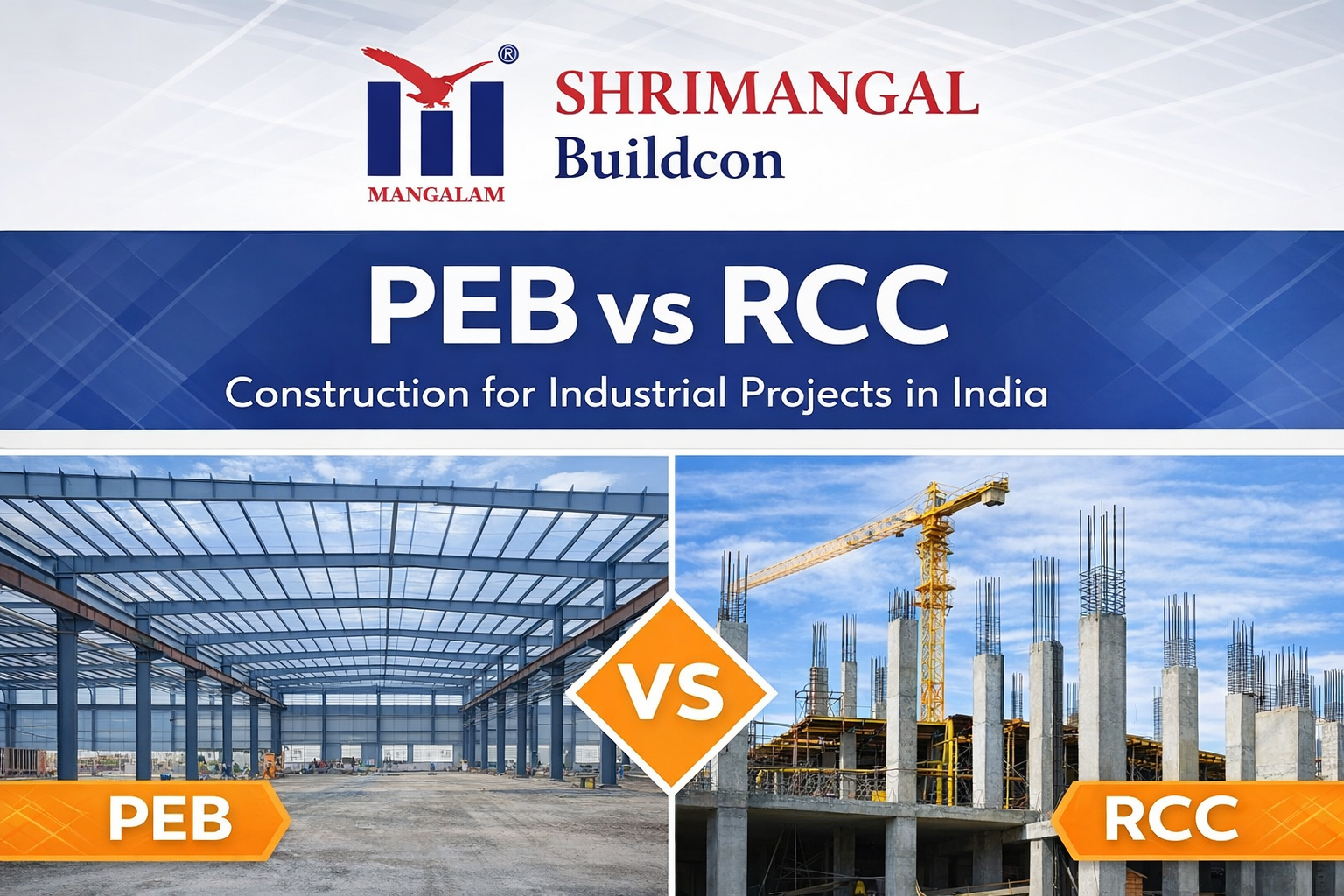
In short: PEB wins on speed, cost, and flexibility. RCC wins on multi-storey capability, heavy point loads, and corrosive environments. Most large industrial projects today use both — PEB for the main structure, RCC for the plinth, floors, and service areas.
Every year, industrial clients spend weeks trying to answer one question before their project kicks off: PEB or RCC? The answer affects construction time, total cost, future scalability, and what your building can actually handle operationally.
Both methods are proven, and both carry clear strengths. The problem is that most comparisons online come from vendors pushing one option. This guide comes from an EPC contractor’s perspective — we build both, so our interest is in giving you the right answer for your project, not the easier one to sell.
What is PEB Construction?
Pre-Engineered Buildings (PEB) use factory-fabricated steel components primary frames, secondary purlins, roof and wall panels that arrive at site ready for bolted erection. Engineers tightly coordinate design, fabrication, and erection, which is why PEB projects move faster than conventional builds.
PEB suits single-storey industrial buildings particularly well: factories, warehouses, cold storage, logistics hubs, and large-span commercial structures. The defining feature is that engineers design the building as a complete system every component works with every other from day one.
What is RCC Construction?
Reinforced Cement Concrete (RCC) uses a cast-in-place or precast concrete frame with steel reinforcement. Moreover, most site teams across India know RCC well local labour and local materials deliver it without specialist supply chains, and it carries decades of track record in multi-storey and heavy industrial applications.
For industrial projects, contractors typically use RCC for plinths, foundations, flooring slabs, mezzanine structures, heavy equipment bases, and facilities where corrosive or high-humidity conditions make steel frame maintenance a long-term concern.
PEB vs RCC — Direct Comparison
| Parameter | PEB | RCC |
|---|---|---|
| Construction time | 3–6 months (faster) | 6–18 months |
| Cost per sq. ft. | ~20–35% lower | Higher (labour + curing) |
| Column-free span | Up to 90m+ achievable | Limited without major structure |
| Multi-storey capability | Not ideal | Naturally suited |
| Future expansion | Easy to extend | Difficult, needs structural work |
| Seismic performance | Good (ductile steel) | Good (if designed for zone) |
| Corrosive environment | Needs coating maintenance | Better natural resistance |
| Foundation requirement | Lighter, less excavation | Heavier foundation needed |
| Sustainability | Higher steel recyclability | Higher embodied carbon |
Where Each Method Works Best
PEB is the right choice when:
- You need the building operational quickly
- Large clear-span areas are required
- Budget is a primary constraint
- Future expansion is likely
- Single-storey factory or warehouse
- Logistics, cold storage, or hangar use
RCC is the right choice when:
- Multi-storey structure is required
- Very heavy concentrated loads involved
- Coastal, chemical, or humid environment
- Vibration-sensitive equipment installed
- Specifications mandate RCC
- Mixed-use or residential elements included
Industry Reality Most industrial projects in India today follow a hybrid approach — contractors build the main structural bay in PEB and construct the plinth, flooring slab, toilet blocks, office annexes, and utility rooms in RCC. As a result, clients get the speed and cost advantages of PEB where it counts, alongside the durability of RCC where the environment demands it.
Cost Breakdown: PEB vs RCC for a 10,000 sq. ft. Factory
These are indicative ranges based on India market rates for 2026. Final costs depend on location, soil conditions, design specifications, and finishing requirements.
| Cost Component | PEB (Approx.) | RCC (Approx.) |
|---|---|---|
| Structural frame | ₹850–1,100 / sq. ft. | ₹1,100–1,500 / sq. ft. |
| Foundation | Lower (lighter loads) | Higher (heavier loads) |
| Construction time | 3–5 months | 8–14 months |
| Labour cost | Lower (factory prefab) | Higher (on-site casting) |
| Overall cost saving | ~20–35% vs RCC | — |
Time = Money in Industrial Construction For a client setting up a factory, every month of delay means a month of lost production. Therefore, a PEB structure that cuts construction time from 12 months to 4 months can recover ₹2–5 crore in lost revenue for a mid-scale manufacturing unit far outweighing the direct cost difference between the two methods.
Common Misconceptions About PEB Construction
1. PEB Structures Are Not as Durable as RCC
A properly specified PEB structure with the correct coating system hot-dip galvanisation, epoxy primer, polyurethane topcoat performs reliably for 30–50 years. Furthermore, PEB handles seismic loads well because steel is ductile; it absorbs energy rather than cracking under stress, unlike rigid concrete frames.
2. PEB Cannot Handle Heavy Loads
Engineers design PEB structures to carry crane loads, overhead material handling systems, and heavy rooftop equipment. The structural design specifies member sizes and connection details based on actual load requirements. In other words, a PEB is not a standard catalogue shed it is a custom-engineered system that engineers build around your operational loads.
3. PEB Is Only for Sheds
This perception comes from PEB’s early adoption in India for basic storage sheds. Today, however, manufacturers and developers use PEB for pharmaceutical plants, food processing units, automobile manufacturing facilities, data centres, and complex multi-span industrial structures. Consequently, the engineering sophistication of PEB has grown considerably over the past decade.
On Hybrid Construction at Shrimangal Buildcon Most of our industrial projects combine both methods. We build the main structure in PEB, construct the plinth and slab in RCC, and integrate electrical, fire suppression, and HVAC into the structure during erection. As a result, clients receive a fully commissioned facility rather than a shell they need to fit out separately.
Which Should You Choose?
There is no universal answer, but a practical framework helps. If your project involves a single-storey industrial building factory, warehouse, processing unit, or logistics hub and you need it fast and within budget, PEB almost certainly works as the right primary method. In addition, you can layer RCC wherever specific conditions demand it.
On the other hand, if your project involves multiple floors, heavy point loads from specialised equipment, or a chemical or coastal environment where steel maintenance becomes a long-term concern, an RCC frame with PEB elements makes better engineering sense.
In either case, the EPC contractor’s quality matters more than the construction method itself. Consequently, method selection is the first decision but contractor selection is the more important one.
Frequently Asked Questions
Is PEB stronger than RCC? ▾
PEB uses high-tensile steel that performs well under dynamic loads, seismic activity, and wind pressure. RCC, on the other hand, performs better where there are heavy point loads, corrosive environments, or multi-storey requirements. Neither is universally stronger — it depends on the load type and application.
How much cheaper is PEB compared to RCC? ▾
PEB construction typically costs 20–35% less than equivalent RCC for single-storey industrial buildings. The savings come from faster construction time, lower labour costs, and factory-controlled fabrication that reduces on-site waste.
How long does a PEB structure last? ▾
A well-maintained PEB structure lasts 30–50 years or more. Lifespan depends on surface treatment quality, coating systems, and maintenance frequency — especially in coastal or high-humidity industrial zones.
Can PEB buildings be expanded later? ▾
Yes. Engineers design PEB structures for modular expansion. Adding bays, extending length, or increasing height is significantly simpler than with RCC. As a result, PEB is a preferred choice when future scalability is part of the project brief.
Which is better for a warehouse PEB or RCC? ▾
PEB is generally better for warehouses because it delivers faster, offers larger column-free spans, and costs less per sq. metre. That said, contractors typically use RCC for the plinth, flooring slab, and ancillary structures within the same complex.
Planning an Industrial Project?
Shrimangal Buildcon handles both PEB and RCC construction under a single EPC contract. Tell us your project brief and we’ll recommend the right approach — with a cost estimate and timeline.Request a ConsultationView PEB Services