
If you’re a factory owner, manufacturer, or industrial developer in India, you face a critical question: How do I plan and execute industrial shed construction efficiently, within budget, and on time?
Industrial sheds form the backbone of India’s manufacturing and logistics ecosystem from warehouses and processing units to assembly lines and storage facilities. Yet, many project owners find themselves confused about construction types, costs, timelines, and which contractor to trust.
In this comprehensive guide, Shrimangal Buildcon an experienced EPC contractor based in Navi Mumbai with 18+ years in industrial construction across Maharashtra and India breaks down everything you need to know about industrial shed construction in 2025.
What is an Industrial Shed?
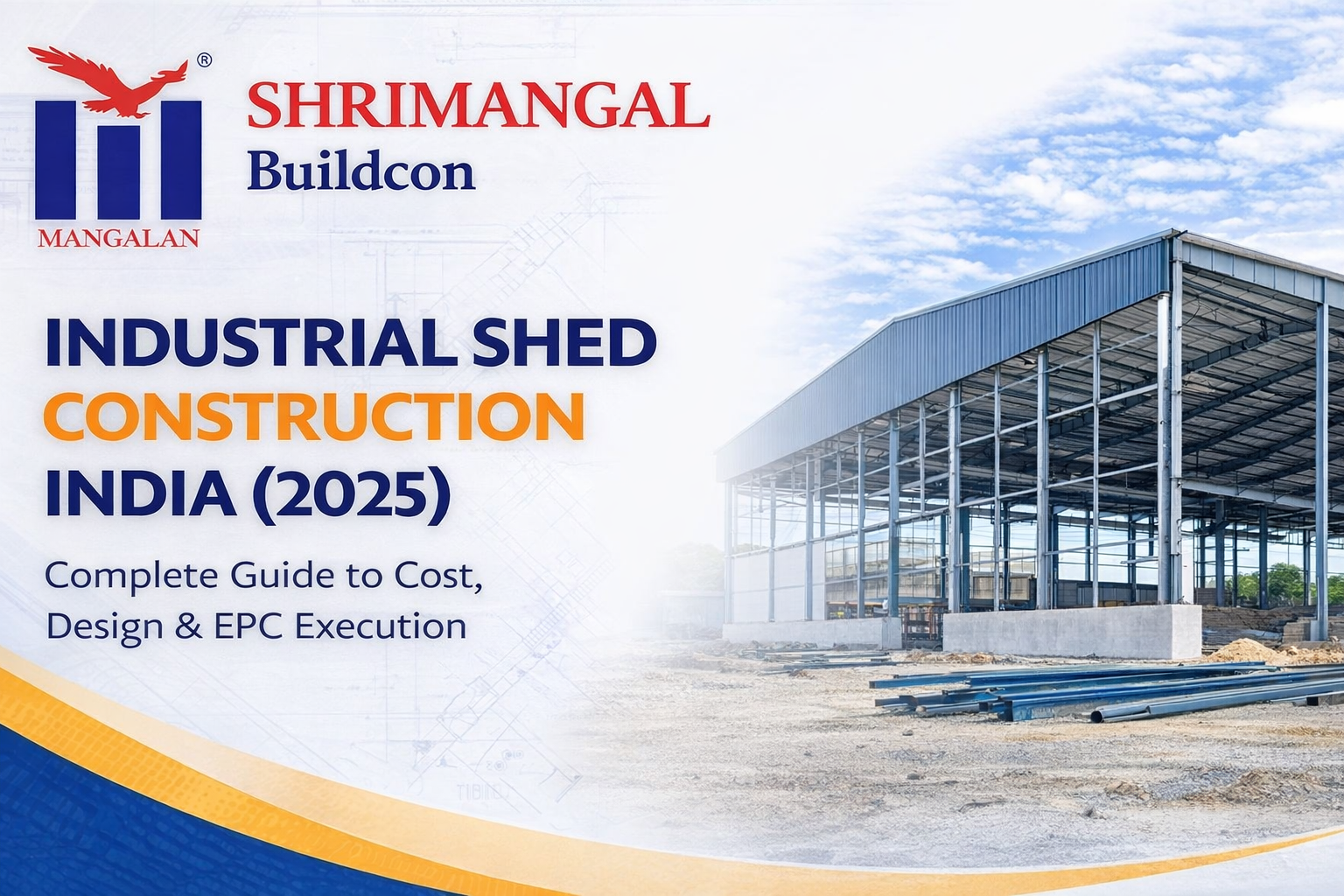
An industrial shed is a large-span, functional structure designed to house manufacturing operations, warehousing, logistics, equipment storage, or processing activities. Unlike conventional buildings, industrial sheds prioritize clear-span space, structural efficiency, load-bearing capacity, and operational workflow over aesthetics.
- Pre-Engineered Buildings (PEB) / Steel Structures – Factory-fabricated steel frames assembled on-site, offering faster construction and cost efficiency.
- RCC (Reinforced Cement Concrete) Structures – Traditional cast-in-place or precast concrete construction, preferred for heavy-load environments or multi-storey facilities.
Types of Industrial Sheds in India (2025 Guide for Manufacturers)
1. Manufacturing / Factory Sheds
Designed for production lines, assembly operations, and fabrication units. These require precise column-free spans, crane runway beams, heavy floor loading, and MEP integration for seamless operations.
2. Warehouse and Logistics Sheds
High-bay structures with wide spans for pallet racking, forklift movement, and goods storage. With the boom in e-commerce and 3PL logistics across India, demand for warehouse construction has surged significantly.
3. Cold Storage Sheds
Insulated panel-based structures with refrigeration systems for food, pharma, or chemical storage. These require vapour barriers, thermal insulation, and specialised electrical infrastructure.
4. Modular Plant / Processing Sheds
Custom-designed facilities for chemical plants, food processing units, and pharmaceutical production. These combine civil, structural, and process engineering requirements within a single structure.
5. Utility / Equipment Storage Sheds
Smaller ancillary structures within industrial campuses for storing raw materials, generators, compressors, or maintenance equipment. Typically built using PEB or steel portal frames for speed and economy.
Industrial Shed Construction Cost in India (2025)
One of the most frequently asked questions by project owners is: How much does industrial shed construction cost in India? The answer depends on structural type, area, location, design complexity, and MEP requirements. Here is a general cost matrix for 2025:
| Shed Type | Structural System | Approx. Cost (per sq ft) |
|---|---|---|
| Basic Storage Shed | PEB / Steel Portal | Rs. 600 – 900 |
| Warehouse / Logistics Facility | PEB with RCC Plinth | Rs. 900 – 1,400 |
| Manufacturing / Factory Shed | PEB or RCC | Rs. 1,200 – 1,800 |
| Heavy-Duty Industrial Plant | RCC / Composite | Rs. 1,800 – 2,800 |
| Cold Storage / Insulated Shed | Insulated PEB | Rs. 1,500 – 2,500 |
Note: These are indicative costs per square foot for Maharashtra and western India. Actual project costs will vary based on site conditions, soil bearing capacity, crane loading, electrical infrastructure, flooring specifications, and fire safety requirements. A detailed EPC estimate from a qualified contractor is always recommended before committing to a budget.
Key Cost Drivers in Industrial Shed Construction
Several critical factors determine the final cost of your industrial shed project. Steel prices form the largest cost component in PEB construction. In most projects, they account for 30–40% of the total cost.Site preparation and foundation design can vary significantly based on soil type, depth to hard strata, and the need for piling. The complexity of MEP works — electrical panels, industrial lighting, HVAC systems, and fire suppression also adds substantially to the project budget. Finally, compliance with MIDC building regulations in Maharashtra can affect both cost and timeline.
PEB vs RCC: Which is Right for Your Industrial Shed?
This is the most consequential structural decision for any industrial shed project. PEB structures offer faster construction timelines typically 30–50% faster than RCC and lower initial cost, especially for clear spans above 15 metres. They are also highly scalable, allowing future expansion with minimal structural intervention. RCC construction remains the preferred choice for heavy-duty manufacturing plants, multi-level industrial buildings, and facilities requiring heavy machinery foundations with vibration isolation.
Many of Shrimangal Buildcon’s industrial projects in Maharashtra adopt a hybrid approach RCC foundations, plinth beams, and mezzanine slabs combined with a PEB superstructure delivering the structural robustness of concrete with the speed and economy of steel above the plinth.
The Industrial Shed Construction Process: Step by Step
Phase 1: Feasibility and Conceptual Planning
Every successful industrial shed project begins with a clear understanding of operational requirements production capacity, equipment layout, utility needs, and future expansion plans. The EPC team works with the client to develop a concept brief, site selection criteria, and a preliminary cost estimate. This upfront planning prevents costly design changes during construction.
Phase 2: Detailed Engineering and Design
Structural design, architectural drawings, MEP engineering, and material specifications are developed. Critical design elements include structural analysis for wind and seismic loads per IS codes, foundation design based on soil investigation reports, crane beam and gantry design, and coordination of process piping and electrical routing within the structure.
Phase 3: Regulatory Approvals and Compliance
In Maharashtra, industrial shed construction within MIDC zones or municipal limits requires building plan approvals, environmental clearances (where applicable), fire NOCs, and structural stability certificates. An experienced EPC contractor handles this liaison process, ensuring approvals are obtained without delays.
Phase 4: Procurement and Supply Chain Management
Material procurement particularly steel sections, roofing and cladding sheets, cement, reinforcement bars, electrical equipment, and finishing materials — must be planned carefully to avoid site stoppages. Under an EPC model, the contractor takes single-point responsibility for procurement, eliminating the project owner’s exposure to material shortages and price escalation risks.
Phase 5: Site Execution and Construction
Ground preparation, earthwork, and soil stabilisation come first. Foundation excavation and casting follows, incorporating reinforced concrete footings, pedestals, and plinth beams. The structural steel or PEB frame is then erected and braced, followed by roofing and wall cladding installation. MEP works are executed concurrently with structural works to compress the overall timeline. Epoxy flooring, industrial painting, and finishes complete the facility.
Phase 6: Commissioning and Handover
The facility is tested across all systems — electrical, fire safety, drainage, and structural integrity — before formal handover. Comprehensive as-built documentation, operation and maintenance manuals, and compliance certificates are provided to the client, enabling a smooth transition to operations.
Key Design Considerations for Industrial Sheds in India
Clear Height and Span: Matching the clear height and span to operational requirements whether for forklift stacking heights, crane hook heights, or assembly line clearances is fundamental. Most modern warehouses and factories in India specify clear heights between 8 and 14 metres depending on use.
Floor Loading Capacity: Industrial floors must be designed for specific live loads typically 5 to 20 tonnes per square metre for heavy manufacturing or racking systems. Epoxy or hardener-treated concrete floors are the industry standard, providing chemical resistance, dustproofing, and easy cleaning.
Ventilation and Lighting: Natural ventilation through ridge vents and translucent roofing sheets can dramatically reduce energy consumption in tropical Indian conditions. Supplemented by industrial exhaust fans and LED high-bay lighting, a well-designed system reduces operating costs while improving worker productivity.
Fire Safety Systems: Industrial sheds storing flammable materials, chemicals, or high-value goods require automatic sprinkler systems, smoke detectors, fire hydrant networks, and safe egress pathways per IS 15105 and local fire authority regulations. Integrating fire safety design from the engineering stage is far more cost-effective than retrofitting.
Expansion Provision: Designing a shed with future expansion in mind through bolted end-wall frames, knockout panels, and extended foundation provisions saves significant cost when capacity needs to be scaled up in the future.
Why EPC is the Smartest Model for Industrial Shed Construction
Many project owners in India attempt to manage construction through multiple separate contractors one for civil, another for structure, a third for electrical. While this might seem cost-effective on paper, it almost always leads to coordination failures, delays, cost overruns, and accountability gaps.
The EPC (Engineering, Procurement, and Construction) model consolidates all of these functions under a single contractor with a fixed-price, time-bound contract. The EPC contractor bears the risk of cost escalation due to procurement delays, design discrepancies, or execution inefficiencies — not the project owner. The client gets a single point of contact, a committed delivery schedule, and a project built to specification without the headache of daily site management.
For industrial shed construction specifically, the EPC model delivers measurable benefits: faster project completion (typically 15–25% faster than conventional contracting), better integration of structural, MEP, and finishing works, and a single warranty covering all elements of construction.
Industrial Shed Construction in Maharashtra: What You Need to Know
Maharashtra remains India’s most active state for industrial construction, driven by its established MIDC industrial zones, the expansion of the Delhi-Mumbai Industrial Corridor (DMIC), strong logistics and port connectivity, and a large manufacturing base spanning automotive, engineering, pharmaceuticals, food processing, and electronics.
Key MIDC zones Navi Mumbai, Taloja, Ambernath, Bhiwandi, Pune, Chakan, Ranjangaon, and Nashik continue to see strong demand for new industrial sheds as manufacturers expand capacity and new investors set up operations. Shrimangal Buildcon has delivered EPC and industrial construction projects across MIDC zones in Navi Mumbai, Thane, Raigad, and the broader Maharashtra region, building deep understanding of local regulatory requirements, soil conditions, and procurement networks.
Common Mistakes to Avoid in Industrial Shed Construction
Inadequate soil investigation: Skipping the geotechnical survey to save cost frequently leads to foundation redesign mid-project — far more expensive than the upfront investigation cost.
Underspecifying electrical capacity: Insufficient transformer capacity and HT/LT distribution infrastructure leads to costly upgrades once operations begin.
Ignoring natural lighting and ventilation: Poor design leads to heavy spending on artificial lighting and mechanical ventilation post-construction.
Choosing a contractor on lowest price alone: A contractor who bids low but lacks capability will cost far more in delays, rework, and disputes than the amount saved on the initial contract.
How Shrimangal Buildcon Delivers Industrial Shed Projects
At Shrimangal Buildcon, we bring 18+ years of EPC and industrial construction experience to every project. Our in-house capability spans structural engineering, civil construction, PEB erection, electrical and power works, industrial painting, and epoxy flooring giving us complete control over quality, schedule, and cost without dependence on multiple sub-contractors.
Our project delivery approach is built around four non-negotiable principles: engineering accuracy at the design stage, procurement discipline to avoid material-related stoppages, execution rigour with daily quality and safety monitoring on site, and transparent communication with clients throughout the project lifecycle.
Whether you need a 5,000 sq ft factory shed in Navi Mumbai’s MIDC, a 50,000 sq ft logistics warehouse in Pune, or a complex turnkey manufacturing plant anywhere in Maharashtra and beyond, Shrimangal Buildcon has the team, systems, and track record to deliver it — on time, within budget, and to the highest quality standards.
Frequently Asked Questions
How long does it take to build an industrial shed in India?
A straightforward PEB warehouse of 10,000–20,000 sq ft with standard specifications can typically be completed in 3–5 months from foundation to handover. Larger or more complex projects may take 6–12 months. Under an EPC model, timelines are contractually defined and the contractor bears responsibility for delays within their control.
What is the minimum size for an industrial shed?
There is no universal minimum size. Small sheds for ancillary storage or light manufacturing can start from 2,000–3,000 sq ft. Most MIDC industrial plots in Maharashtra start from 1,000 sqm (approximately 10,760 sq ft), with the shed footprint typically 60–75% of the plot area depending on FAR regulations.
Can an industrial shed be expanded after construction?
Yes particularly PEB structures, which are inherently designed for future expansion. A qualified EPC contractor builds in expansion provisions from the initial design stage, allowing lateral extension or additional bays without disrupting operations.
What permits are required for industrial shed construction in Maharashtra?
Typically required: building plan approval from MIDC or local authority, structural stability certification, fire NOC, electricity connection approval, and environmental clearance where applicable. An experienced EPC contractor familiar with Maharashtra’s regulatory framework will manage this process as part of the EPC scope.
Ready to Build Your Industrial Shed?
Shrimangal Buildcon is your trusted EPC partner for industrial shed construction in India. With a proven track record of 350+ projects, an in-house engineering team, and a commitment to quality that exceeds industry standards, we are ready to help you build the facility your business needs.
Contact us today for a free consultation and project estimate. Let’s build something great together.
Call: +91 7304241242 | Email: info@shrimangalbuildcon.com | Office: CBD Belapur, Navi Mumbai