

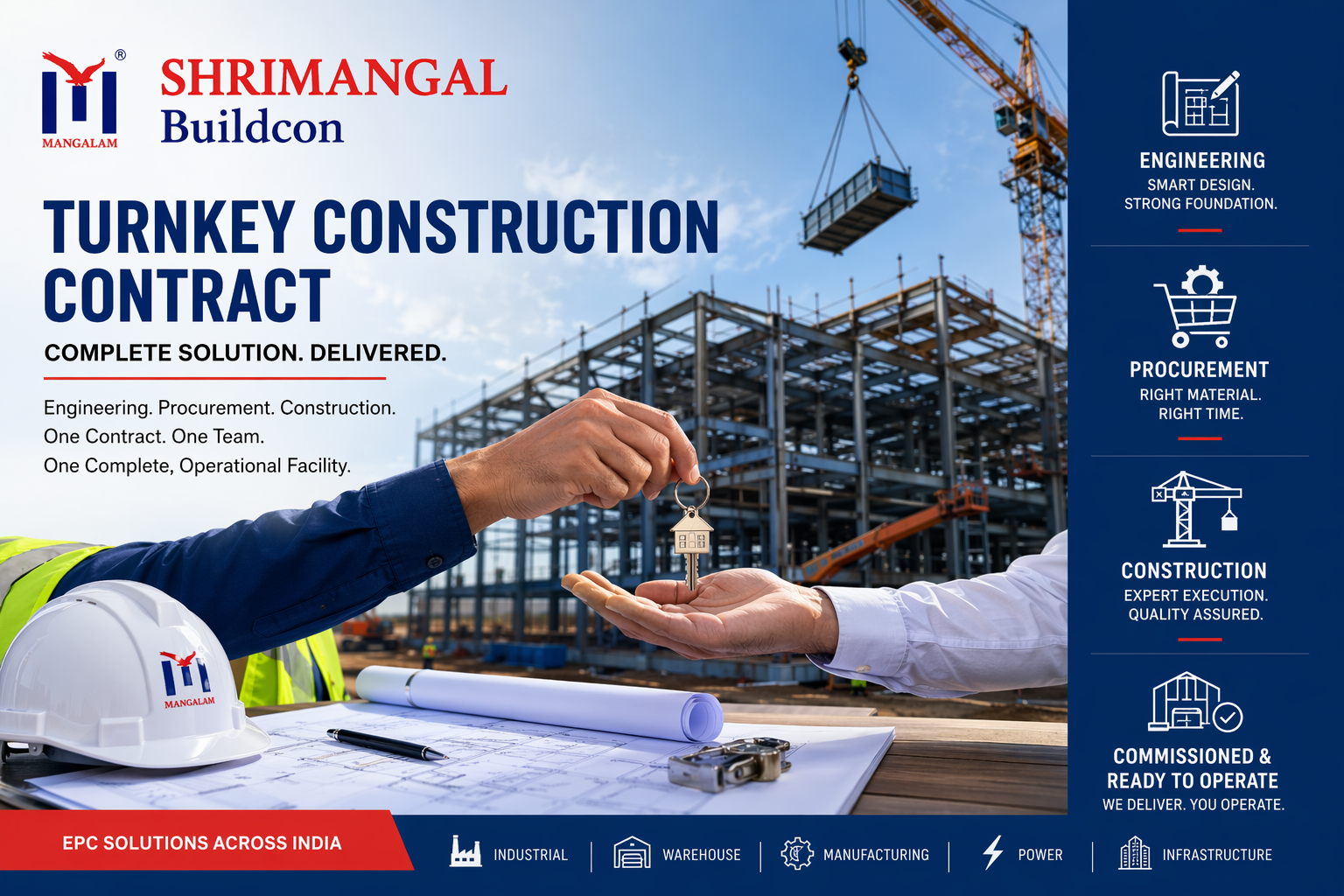
Turnkey construction is one of the most effective project delivery models available to industrial and commercial clients today. Under a turnkey construction contract, a single contractor takes full responsibility for engineering, procurement, and construction. At the end, the client receives a completed, operational facility ready to use. This guide explains how turnkey construction works, why businesses choose it, and what to look for before signing a contract.
What Is Turnkey Construction?
Turnkey construction is a project delivery method where one contractor manages every phase under a single contract. Engineering, procurement, and construction all sit with one firm. The client defines the requirements and the budget at the start. After that, the contractor drives the entire project through to completion and delivers a ready-to-operate facility. This is why turnkey construction is also called an EPC contract, short for Engineering, Procurement, and Construction.
In practice, this approach differs significantly from the traditional model. In a traditional project, the client hires separate architects, consultants, suppliers, and contractors for each phase. With this model, one contractor handles design coordination, vendor selection, material procurement, site execution, quality checks, and commissioning together. As a result, the client deals with one team and one contract from start to finish.
How Does a Turnkey Construction Contract Work?
An EPC project moves through three core phases. Understanding each phase helps clients know exactly what to expect before committing to this model.
The first phase is Engineering. The turnkey contractor develops detailed design drawings, structural layouts, electrical schematics, and project specifications. In a traditional contract, clients usually pay separate consultants for this. Under this contract, the same firm that will build the facility also designs it. This ensures the design reflects real-world construction requirements and reduces costly mid-project changes.
The second phase is Procurement. The contractor sources all materials, equipment, and components the project needs. Because the contractor manages procurement directly, they negotiate with vendors, control quality at source, and schedule deliveries to match the site timeline. Specifically, this matters enormously, since procurement delays cause more project overruns than almost any other single factor.
The third phase is Construction. The contractor mobilises the site team, executes civil and structural work, installs mechanical and electrical systems, and runs commissioning. Commissioning in this model is a formal process. The contractor tests every system and confirms the facility meets the agreed performance standards before handover. The client receives a fully operational building, not a shell that needs further fit-out work.

Turnkey Construction vs Traditional Construction
The core difference between turnkey construction and the traditional model is accountability. In a traditional project, the client manages multiple contracts at once. An architect produces the design. A consultant prepares the bill of quantities. A civil contractor builds the structure. An electrical contractor installs the systems. When delays or disputes arise, each party points to the others. The client absorbs the cost overrun, the schedule slip, and the coordination burden.
This approach removes that problem entirely. One contractor owns the outcome. If the design needs revision, the contractor fixes it. If a vendor delivers late, they resolve it. If a civil and electrical scope conflict, they coordinate it internally. This single-point accountability model is why industrial clients, infrastructure developers, and factory owners consistently prefer the turnkey model for complex projects.
Furthermore, this approach typically delivers better cost certainty. Because one contractor controls all three phases, they price the project more accurately upfront. Variations still happen, but they have stronger visibility over the full scope and manages contingencies without passing every change back to the client.
Industries That Rely on Turnkey Construction
This project delivery model is especially common in sectors where project complexity is high and operational timelines are tight. Manufacturing plants, warehouse and logistics facilities, pharmaceutical production units, power infrastructure, food processing plants, and chemical processing facilities all use this model for new builds and expansions. Overall, any project with multiple interdependent scopes benefits from the single-point accountability that turnkey construction provides.
In India, the EPC model has grown steadily across industrial corridors in Maharashtra, Gujarat, Telangana, and Karnataka. Factory owners and developers choose it because it reduces the project management burden on their internal teams. For a company focused on its core business, handing the entire build to an EPC contractor is a far more efficient use of resources than managing a complex multi-vendor project independently. According to the NITI Aayog infrastructure guidelines, integrated project delivery models like EPC improve cost and schedule performance on large infrastructure projects.
What to Look for in a Turnkey Contractor
Choosing the right partner matters as much as the contract structure itself. First, look for a contractor with proven experience in your specific project type. A firm experienced in pharmaceutical plants is not automatically equipped to deliver a steel fabrication facility. Industry-specific experience reduces risk considerably. Ask the contractor to walk you through projects similar to yours, including the challenges they encountered and how they resolved them.
Second, examine their in-house capabilities. A genuine EPC contractor carries engineering, procurement, and construction expertise internally. In contrast, firms that subcontract all three phases to others are not truly turnkey; they are project brokers. Ask specifically which capabilities they own and which they outsource.
Third, review their project management systems. This model succeeds when the contractor runs disciplined scheduling, procurement tracking, and quality assurance processes. As a result, contractors who invest in these systems deliver more predictable outcomes. Request references, ask for case studies, and visit completed projects before committing. A confident contractor will welcome that scrutiny.
Shrimangal Buildcon: Turnkey Construction Across India
Shrimangal Buildcon delivers EPC turnkey construction solutions for industrial and commercial projects across India. With 18 years of experience, the company manages engineering, procurement, and construction under a single contract and hands over fully operational facilities. Services span PEB and structural engineering, civil construction, electrical works, and plant renovation and upgradation.
Shrimangal Buildcon operates across Mumbai, Pune, Hyderabad, Bangalore, Chennai, Gujarat, and Delhi NCR. For clients evaluating EPC partners, the company offers single-point responsibility from concept through commissioning. To discuss your project requirements, contact the Shrimangal Buildcon team.

Frequently Asked Questions
What does turnkey construction mean?
Turnkey construction means a single contractor manages all project phases, including engineering, procurement, and construction, and delivers a completed, fully operational facility. In other words, the client does not manage separate vendors or contractors at any stage. Instead, they receive a working facility on handover day and begin operations immediately.
What is the difference between an EPC contract and a turnkey construction contract?
In most contexts, EPC contract and this contract type refer to the same model. EPC stands for Engineering, Procurement, and Construction, which are the three phases the contractor manages. Some contracts add commissioning and use the term EPCC. The core principle of single-point accountability remains the same in both cases.
What are the main advantages of turnkey construction?
The main advantages are single-point accountability, better cost control, reduced project management burden on the client, and faster delivery through integrated planning. Because one contractor manages all three phases, coordination gaps drop significantly compared to the traditional multi-contract model.
Is turnkey construction more expensive than the traditional model?
Not necessarily. This model often delivers better cost certainty because the contractor prices the full scope upfront. The traditional model frequently looks cheaper at the tender stage but accumulates variation costs, delay penalties, and coordination overheads that raise the final project cost considerably. Many clients find it delivers stronger value over the full project lifecycle.
Which types of projects suit turnkey construction?
This model suits projects with high complexity, tight timelines, and multiple interdependent scopes. Industrial plants, warehouses, pharmaceutical facilities, power infrastructure, and large commercial developments all benefit from this model. It works best when the client wants a ready-to-operate facility delivered with minimal day-to-day involvement in project management.