
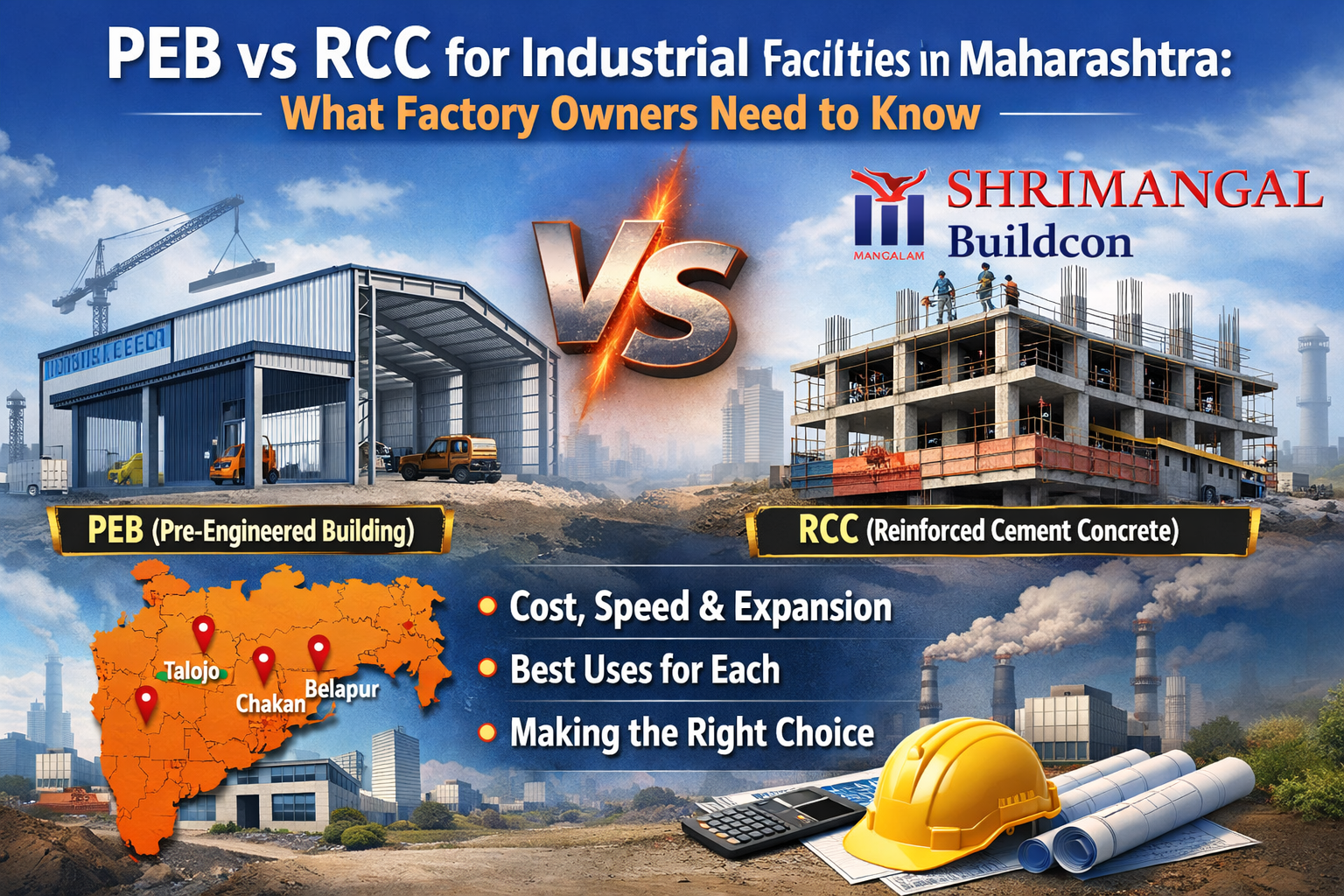
If you’re planning an industrial facility in Maharashtra, you’ll hit this question early: PEB vs RCC industrial construction — which one is right for your project? Whether it’s a warehouse near Taloja MIDC, a manufacturing unit in Chakan, or a logistics hub in CBD Belapur, the answer isn’t obvious. Most contractors will push whichever method they’re better at executing. This guide breaks down where each method actually works, what it costs, and how to decide based on your project — not someone else’s.
Most contractors will push whichever method they’re better at executing. This guide doesn’t do that. It breaks down where each method actually works, what it costs in Maharashtra’s current market, and how to decide based on your specific project — not someone else’s.
What These Two Construction Methods Actually Are
A pre-engineered building (PEB) is a steel structure where the primary components — columns, rafters, purlins, roof and wall panels — are designed and fabricated at a factory, then transported to site and bolted together. The structural engineer designs everything in advance based on your span requirements, load specifications, and site conditions.
An RCC (Reinforced Cement Concrete) structure is built conventionally on-site: formwork, rebar placement, concrete pouring, curing. The structure is cast in place and gains its strength over time. Most industrial buildings in Maharashtra built before 2010 are RCC.
Neither is categorically better. They solve different problems.
Where PEB Has a Clear Advantage
Speed of Construction
This is the most significant difference in practice. A 5,000 sq ft industrial shed in PEB can reach handover in 8–12 weeks once the foundation is ready. The same footprint in RCC typically takes 5–7 months.
For businesses setting up in MIDC zones under a licence timeline or expansion deadline, that gap matters. Every month of delayed commissioning is revenue deferred.
Large-Span Structures Without Internal Columns
PEB handles clear-span widths of 15m to 50m+ with relative ease. If you’re building a warehouse or manufacturing floor where internal columns would disrupt material flow, racking layout, or equipment placement, PEB gives you that flexibility without a structural penalty.
RCC can achieve large spans too, but it gets expensive quickly past 15m. You’d need deep beams and heavy columns that eat into usable floor space.
Cost-Efficiency for Warehousing and Logistics Facilities
For straightforward warehouse typologies — storage, distribution, light manufacturing — PEB typically costs 20–35% less than RCC per sq ft. In Maharashtra’s current market, PEB industrial sheds are coming in at approximately ₹1,200–1,800 per sq ft (structure only, excluding civil, electrical, and interiors), depending on span, height, and loading requirements.
Expandability
PEB structures can be extended laterally or lengthwise with relative ease. You add new bays using the same bolt-connection system. RCC expansions require demolishing walls, cutting into existing structure, and casting new columns — a messier, more disruptive process.
Where RCC Makes More Sense
Multi-Storey Industrial or Commercial Structures
PEB is fundamentally a single-storey or low-rise solution. If you’re building a multi-floor factory, a pharma facility with separate GMP floors, or a commercial-industrial mixed building, RCC remains the standard.
Pharma, Chemical, and Process Industries
Industries governed by GMP (Good Manufacturing Practice), PESO, or CPCB norms often need specific wall constructions, corrosion-resistant surfaces, and clean-room environments. RCC gives architects and engineers more control over the building envelope, drainage design, and surface finishes required in these sectors.
That said, PEB can work for the shell even in pharma — many pharma companies in Pune-Chakan use PEB for their outer shell and RCC for internal utility structures.
Heavy Equipment Foundations and Vibration-Sensitive Processes
If your plant involves presses, compressors, or equipment that generates significant dynamic loads, the foundation and flooring requirements will drive you toward RCC regardless of what you choose for the superstructure.
Buildings That Need to Look Permanent
RCC buildings signal permanence in a way that a steel shed doesn’t. If you’re building a headquarters, a guest facility, or an office block adjacent to your plant, most clients and developers prefer the finish quality RCC enables.
A Practical Comparison Table
| Factor | PEB Structure | RCC Structure |
|---|---|---|
| Construction Speed | 8–14 weeks (after foundation) | 5–8 months |
| Cost per sq ft (structure) | ₹1,200–1,800 | ₹1,800–2,800+ |
| Clear Span Capability | Up to 90m+ (standard: 15–50m) | Practical up to 15m economically |
| Future Expansion | Easy — bolt-on bay additions | Complex — structural modification needed |
| Multi-Storey Feasibility | Limited (ground floor to mezzanine) | Fully capable |
| Finish Quality | Industrial standard | High (with plastering, tiling, etc.) |
| Regulatory Compliance (GMP, PESO) | Possible with internal partitions | Better suited for process industries |
| Seismic Performance (IS 1893) | Good — light steel structure | Good — depends on design zone |
What the Market Looks Like in Maharashtra’s MIDC Zones Right Now
Most new industrial construction happening in Taloja MIDC, Mahad, Ambernath, Chakan, and Khopoli is PEB-first for warehousing and light manufacturing. The volume of logistics activity post-2020 drove this shift — investors and PE-backed warehousing companies want fast ROI, and PEB gives them a commissioned building before the monsoon season they’d otherwise wait through.
What’s less discussed is the hybrid approach many serious industrial developers now use: PEB for the main manufacturing or storage hall, RCC for the admin block, guard rooms, utility sheds, and structural core. This gives you the speed and cost benefits of PEB where span matters most, and the finish and permanence of RCC where it’s visible.
At Shrimangal Buildcon, a meaningful share of our EPC projects in Navi Mumbai and surrounding MIDC zones use this hybrid model. It’s not always the first thing a client asks for, but it’s usually what makes engineering and economic sense once the brief is properly understood.
Questions to Ask Before You Decide
Before locking into a structural system, run through these:
- What’s your operational start deadline? If you need to commission within 4 months of breaking ground, PEB is likely your only realistic option.
- What’s going inside the building? Storage racks and assembly lines favour PEB’s clear spans. CNC machines, process equipment, and cleanrooms may need RCC’s flexibility in internal layouts.
- Are you planning to expand in 5 years? PEB expansion is significantly cheaper and faster. If growth is on the roadmap, design for it now.
- Is this a leased MIDC plot or owned land? Leased plots with shorter tenure sometimes make PEB more attractive — the structure has resale value as components and can technically be relocated.
- What do your statutory approvals allow? Some MIDC plots have FAR, setback, and height restrictions that affect which structural system is more efficient. A good EPC contractor will cross-reference your approval drawings with the structural design early.
How an EPC Contractor Helps You Navigate This
The reason the PEB-vs-RCC question is often answered poorly is that most builders are specialists in one method. A fabricator will tell you PEB is always better. A conventional civil contractor will push RCC.
An EPC contractor with in-house capability in both — civil, structural, electrical, and PEB design — can give you a genuine recommendation based on your brief. They’ll model both options, show you the cost difference, and flag the operational implications. That’s not a common service. Most firms quote what they can execute profitably, not what’s best for the client’s long-term operations.
If your EPC partner can’t draw up a comparison for your specific project, that’s a red flag worth noting before you sign anything.
Frequently Asked Questions
How long does a PEB industrial building last?
A properly designed and maintained PEB structure has a service life of 30–50 years. The steel used in Indian PEB systems typically conforms to IS 2062 (structural steel) standards. Corrosion protection — through hot-dip galvanizing or zinc-aluminium coatings on purlins, and epoxy or polyester coatings on roof and wall panels — is the main factor determining longevity. In coastal MIDC zones like Taloja and Dronagiri, specify enhanced corrosion protection upfront.
Can a PEB structure be built in an existing MIDC industrial plot with utilities?
Yes. PEB construction requires a prepared RCC foundation and anchor bolts cast in place before the steel erection begins. The foundation work can be completed independently, and the steel structure erected once the concrete has cured. This sequencing actually works well on MIDC plots where other utilities or boundary walls are already in place — the crane and erection crew need less space than a full conventional construction site.
What is the approximate cost of a 10,000 sq ft PEB warehouse in Navi Mumbai (2025)?
A basic 10,000 sq ft PEB shed with 6m eave height, single-slope roof, standard insulation, natural ventilation, and no mezzanine would typically be budgeted at ₹1.4–1.8 crore (structure and cladding only). Add approximately ₹25–40 lakh for civil work (foundation, flooring, drainage), ₹15–25 lakh for basic electrical, and ₹10–20 lakh for a dock leveller, security cabin, and compound wall. Total project cost in the ₹2–2.8 crore range is realistic for a functional industrial shed of that size in Navi Mumbai. Scope varies significantly with fit-out requirements.
Is RCC construction mandatory for pharma plants in MIDC zones?
Not categorically. Schedule M and WHO GMP guidelines specify requirements for flooring, wall finishes, ceiling heights, drainage, HVAC, and air quality — but do not mandate the structural system. Many small-to-medium API (Active Pharmaceutical Ingredient) and formulation units use a PEB superstructure with internal RCC mezzanines and partition walls to meet GMP requirements. The key is involving your regulatory consultant and the structural engineer at the pre-design stage, not after the shell is decided.
Can Shrimangal Buildcon handle both PEB and RCC structures in a single project?
Yes. Our EPC capability spans civil construction, PEB design and erection, structural steel works, electrical, and industrial painting. For clients who need a hybrid approach — PEB for the main production or storage hall, RCC for the admin block or utility structure — we manage the complete scope under a single contract, which keeps accountability clear and coordination overhead low.
What approvals are needed for an industrial building in MIDC Maharashtra?
For MIDC allottees, the standard approvals include MIDC building plan sanction, commencement certificate, fire NOC from the local fire brigade, and environment clearance where applicable (based on industry type). The MIDC’s online portal (midc.maharashtra.gov.in) handles most plan submissions. For certain industries — chemical, pharma, hazardous waste handling — additional clearances from MPCB (Maharashtra Pollution Control Board) and PESO (Petroleum and Explosives Safety Organisation) are required. A competent EPC contractor with MIDC experience will know which apply to your sector.
How do I evaluate whether an EPC contractor is quoting a realistic price?
The simplest check is to ask for a bill of quantities (BOQ) alongside the lump-sum quote. A BOQ lists the quantities and rates for each item of work — steel tonnage, concrete volume, electrical load, etc. Contractors who refuse to share a BOQ are typically protecting a margin built on scope ambiguity. You should also check whether the quote includes foundation design, statutory fees, third-party inspection, and project insurance — these are often excluded and can add 8–12% to the base figure.
Does Shrimangal Buildcon work outside Navi Mumbai?
Our primary project base is in Navi Mumbai, Thane, Pune, and the MIDC zones of the Mumbai Metropolitan Region. We’ve also executed projects in Pune district and Raigad. If your site is within Maharashtra, we’re worth a conversation. Projects outside the state are evaluated on a case-by-case basis depending on scope and duration.
Final Word
The PEB vs RCC decision should follow the brief, not the other way around. If you’re building a logistics facility under a timeline, PEB wins on almost every dimension. If you’re building a multi-storey pharma plant or an office-fronted commercial structure, RCC will serve you better.
What you want is a contractor who’s genuinely indifferent between the two methods — one whose advice you can trust because their margin doesn’t depend on which you pick. That’s a harder thing to find than it sounds.
If you’re planning an industrial facility in Maharashtra and want an honest assessment of what makes sense for your project, reach out to us at Shrimangal Buildcon. We’ll review your plot details, brief, and timeline — and tell you what we’d actually build if it were our money.